
How to Choose an Enterprise AI Agent Development Partner
October 19, 2026
AI Agent
Enterprise AI

Most enterprise AI agent projects don't fail at the pilot stage. They fail at the handoff between "this works in a demo" and "this runs in production without someone babysitting it." According to Deloitte's 2026 Tech Trends research, 38% of tech leaders say their organizations are piloting agentic AI, but only 11% have agents actually running in production. That gap is the single biggest risk in this buying decision, and it has less to do with the technology than with who you hire to build it.
An AI agent is different from a chatbot. A chatbot answers questions. An agent plans a sequence of steps, calls tools or APIs to gather information and take action, and adjusts when something doesn't go as expected, all with limited human intervention. That distinction matters because it changes what you should be evaluating in a partner: not "can you build a conversational interface," but "can you build a system that reliably touches our CRM, our ERP, and our compliance workflows without breaking things".
This article walks through the decision in the order it actually needs to happen: whether to build, buy, or bring in a partner at all, what to evaluate once you've decided a partner makes sense, and the red flags that tell you to walk away before you sign a statement of work.
What an Enterprise AI Agent Development Partner Actually Does
Beyond chatbots: agents that plan, decide, and act
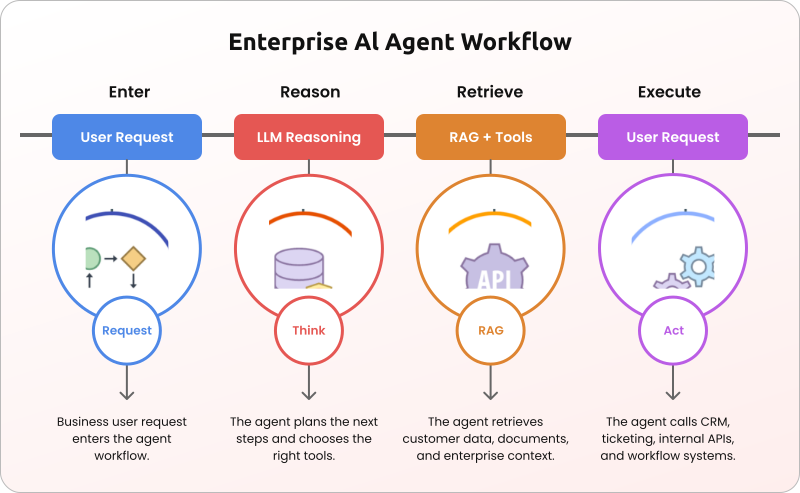
An enterprise AI agent typically combines three things: a large language model (LLM) for reasoning, an orchestration layer that sequences tasks and decides what to do next, and tool or API connections that let the agent actually do something in your systems, like pulling a customer record, updating a ticket, or triggering a downstream workflow. Many implementations also use retrieval-augmented generation (RAG) to ground the agent's responses in your own documents and data instead of relying only on what the model already knows.
A development partner's job is to design and build that combination for your specific workflows, not to hand you a generic chatbot with a new label. The table below shows the practical difference.
| Chatbot | AI Agent | |
|---|---|---|
| Primary function | Answers questions in a conversation | Plans and executes multi-step tasks |
| Takes action in your systems | Rarely, usually read-only | Yes, through tool/API calls |
| Handles ambiguity | Limited, often escalates to a human | Can adjust its approach mid-task |
| Typical enterprise use | FAQ support, basic self-service | Claims processing, onboarding workflows, internal ops automation |
Where partners typically fit: platform vendor vs. custom build vs. delivery partner
Vendors in this space fall into a few categories, and it's worth being clear about which one you're actually talking to. A platform vendor sells you a product, an agent-building tool you configure and largely maintain yourself. A pure custom-build shop will write code to your specifications but may have limited experience with the orchestration and integration patterns specific to agents. A delivery partner, which is where Ccube operates, combines architecture expertise with hands-on implementation and ongoing support, using either its own platform components or your existing tools depending on what fits.
None of these models is inherently better. The right one depends on your internal capability and the decision covered next.
Build, Buy, or Partner: Making the Right Call First
Before you evaluate a single vendor, decide which of these three paths actually fits your situation. Skipping this step is the most common reason enterprise AI agent projects stall, and it's a gap most vendor content on this topic skips over entirely (often because the content is written by a platform vendor with an obvious answer).
When an internal build makes sense
An internal build works when you already have engineers with LLM application experience, a mature data and API layer that agents can safely connect to, and enough time (usually 6 to 12 months) to absorb the learning curve. Companies with strong internal AI/ML teams and low urgency are the best fit here. The risk is underestimating how much orchestration, evaluation, and production-hardening work sits between a working prototype and something reliable enough to run unattended.
When a platform vendor is the faster path
A platform vendor makes sense when your use case is narrow and well-supported by an existing product, such as customer support deflection or internal IT ticket triage, and you have the internal resources to configure and maintain the tool yourself. You'll move faster initially, but you take on vendor lock-in and are constrained by whatever the platform's roadmap supports.
When a delivery/implementation partner is the right fit
A delivery partner is the right call when you need production-grade integration with existing enterprise systems, industry-specific compliance requirements (BFSI and healthcare being the clearest examples), or you don't have the internal bandwidth to own the build and maintenance long-term. This is also the path that gives you the most architectural flexibility, since a good delivery partner isn't tied to selling you one particular platform. Ccube's enterprise AI platform capabilities are one example of how a delivery partner can bring platform-level components into a custom engagement without locking a client into a single closed product.
What to Evaluate in an Enterprise AI Agent Development Partner
Once you've decided a partner is the right path, evaluate candidates against specific, checkable criteria rather than general adjectives. Use this as a working scorecard.
| Criteria | What Good Looks Like | Red Flag |
|---|---|---|
| Technical capability | Can explain their orchestration approach, tool-calling design, and how they handle model errors or hallucinations | Vague answers about "using AI" with no architecture detail |
| System integration | Named experience integrating with systems like Salesforce, ServiceNow, SAP, or Azure AD, with a description of how they handle authentication and data sync | Integration described only in general terms, no specifics on your actual stack |
| Security & compliance | Clear answers on data residency, access controls, and relevant standards (SOC 2, GDPR, HIPAA where applicable), and can point to how compliance is handled in prior projects | Compliance treated as an afterthought or "we'll figure it out during the build" |
| Production readiness | Track record of agents running in production, not just demos, with a description of monitoring and fallback handling | Only demo-stage or "coming soon" examples |
| Pricing & ROI | Transparent pricing tied to defined milestones, and a way to measure ROI (time saved, error reduction, throughput) before full rollout | Open-ended pricing with no milestone structure, or ROI framed only in vague terms |
Technical capability and architecture experience
Ask candidates to walk through how their agents handle a task that doesn't go according to plan, for example, what happens when an API call fails or a data field is missing. Their answer tells you whether they've actually operated agents in production or only built prototypes.
Enterprise system integration track record
Integration is where most agent projects run into trouble, because production systems have authentication requirements, rate limits, and data quality issues that don't show up in a sandbox demo. Ask for specifics on how a candidate partner handles system-of-record updates, not just data retrieval.
Security, data privacy, and compliance
For regulated industries, this isn't optional. A BFSI organization evaluating an agent for transaction monitoring or fraud review needs a partner who can speak concretely to data handling, audit trails, and model explainability. A healthcare organization building an agent that touches patient scheduling or intake needs HIPAA-aware design from day one, not a retrofit after the pilot.
Production readiness (not just pilots or demos)
Ask directly: how many of your agent projects are currently running in production, versus stalled at pilot? Given that Deloitte's research puts industry-wide production rates at roughly 11% against 38% in pilot, a partner who can point to actual production deployments, not just proofs of concept, is demonstrating something meaningfully rarer than it sounds.
Pricing transparency and ROI measurement
A credible partner should be able to tie cost to a defined scope and milestones, and should help you define what success looks like (time saved, error rate, volume handled) before the build starts, not after.
Red Flags to Watch For
- No clear ROI measurement plan. If a vendor can't describe how you'll know the agent is working before full rollout, that's a planning gap, not a minor detail.
- Only demo-stage examples. Ask specifically whether referenced work is in production or still a pilot. Vague answers here are common and worth pressing on.
- Single-model lock-in. A partner whose entire approach depends on one LLM provider limits your flexibility if pricing, performance, or availability changes.
- Unrealistic timelines with no scoping detail. Enterprise integration work takes time to scope properly; a partner promising a full production rollout in a few weeks, with no discovery phase, is often underestimating the integration work.
- Technology-first pitches. If the conversation starts with "here's our platform" instead of "here's how we'd solve your specific workflow problem," the engagement is likely to be more about their product than your outcome.
- No discussion of governance or monitoring after go-live. An agent that ships without a plan for ongoing monitoring, retraining, or human oversight is a maintenance problem waiting to happen.
Practical Considerations for Enterprise Buyers
A few enterprise factors are worth confirming explicitly before you sign anything: who owns the data the agent touches and where it's stored, how the system scales if usage grows well beyond the pilot, and how much of the integration work depends on your own IT team's availability versus the partner's. None of these need a long section on their own, but skipping them at the proposal stage is a common source of budget overruns later.
Making the Decision
Choosing an
enterprise AI agent development company for a specific use case comes down to matching the partner's track record to your actual integration and compliance requirements, not to whichever pitch sounds the most polished. A partner-first evaluation, one that treats platform selection and delivery partnership as two separate decisions, tends to surface better-fit vendors than a generic checklist applied to every vendor type. CCube works from this same delivery-partner position, using structured 30-60-90 day roadmaps and engagement models like Strategy Blueprint, Turnkey Managed, and Talent Surge depending on how much of the build and ongoing ownership a client wants to retain.
Unsure Which Engagement Model Fits Your Project & Ownership Goals?
Find the right balance between control and speed. Explore how Ccube’s 30–60–90 day roadmaps - across Strategy Blueprint, Turnkey Managed, and Talent Surge models help you structure a delivery-partner engagement in practice.
Frequently Asked Questions
How long does an enterprise AI agent deployment typically take?
It depends heavily on integration complexity. A narrow, well-scoped use case with clean API access can move from discovery to production in a matter of weeks. A project involving multiple legacy systems or strict compliance review typically takes longer, and any partner quoting a firm timeline before a discovery phase should be questioned on how they arrived at it.
Is an AI agent development company the same as an AI agent platform vendor?
No, and the distinction matters. A platform vendor sells a product you configure and largely run yourself. A development company or delivery partner builds and often helps operate a solution tailored to your systems, which may or may not include a platform component.
What's the biggest reason enterprise AI agent projects stall after the pilot?
Based on the pattern seen across the industry, the most common cause is integration and governance work that wasn't scoped up front, not a failure of the underlying model. Production readiness requires monitoring, fallback handling, and compliance review that a demo environment doesn't need.
Ready to ship your next AI initiative?