
The Enterprise Guide to Deploying Production AI & GenAI in 90 Days
September 29, 2026
Enterprise GenAI
90-Day Deployment

Production AI deployment is the process of moving a generative AI system from an isolated proof of concept into a governed, monitored system that runs inside live business workflows. An effective enterprise GenAI strategy treats architecture, data readiness, and governance as day one requirements, not post launch cleanup.
Most enterprises don't actually have a model problem. They have a production problem. Teams get a GenAI pilot working in a sprint or two, the demo impresses the room, budget gets approved for 'the next phase,' and then the project quietly stalls somewhere between the demo and the deployment. It can sit there for months.
McKinsey has a name for that gap in its research on enterprise AI adoption: Pilot purgatory. Most organizations are now using generative AI somewhere in the business, yet a much smaller group can point to real bottom line impact from it. The companies pulling ahead aren't using better models. They're running a different deployment process, and that process is the subject of this guide.
What follows is a 30/60/90 day framework for taking enterprise GenAI from strategy to production: the architecture decisions that decide whether a system scales, and the governance work that keeps legal, security, and compliance from blocking launch at the finish line, which is where we've watched more than one otherwise well built project stall.
What "Production AI" Actually Means (vs. a Pilot)
A pilot proves a model can do something. Production proves it can do that thing reliably, securely, and repeatedly, at the volume the business actually needs, without a human quietly checking every output behind the scenes.
| Dimension | Pilot | Production |
|---|---|---|
| Data access | Static sample dataset | Live connection to source systems with access controls |
| Users | 5 to 20 internal testers | Hundreds to thousands of employees or customers |
| Failure handling | Manual review of every output | Automated evaluation, fallback logic, human review for edge cases |
| Cost visibility | Ignored | Tracked per request, budgeted, alerted |
| Governance | None | Logged, auditable, mapped to a risk framework |
| Uptime expectation | Best effort | SLA backed |
The jump from the left column to the right column is where most enterprise AI initiatives quietly die. It isn't a model upgrade. It's an engineering, data, and governance build out that a chatbot demo never had to reckon with.
Why 90 Days Works as a Deployment Horizon
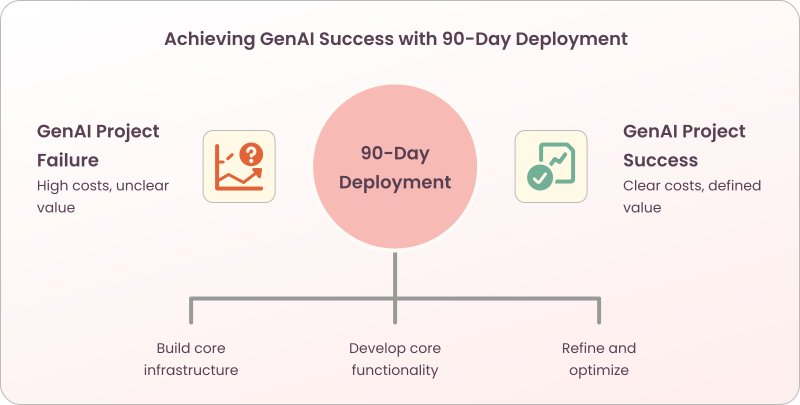
Ninety days is long enough to build something real and short enough to force scope discipline. It maps naturally to three phases enterprise IT already understands: foundation, build, and hardening. It also forces an early, honest answer to the question that quietly kills most GenAI budgets around month four: what does this actually cost to run once real users show up.
Gartner's research on enterprise AI project outcomes is a useful reality check here. Its analysts expect over 40 percent of agentic AI projects to be canceled by the end of 2027, largely because costs escalate and business value stays unclear until well after the initial rollout. A compressed, milestone driven timeline forces those cost and value questions into week four instead of month nine, when it's still cheap to change course.
The Four Barriers That Kill GenAI Projects Before Production
| Barrier | What It Looks Like | Where It Bites |
|---|---|---|
| Fragmented data | Model works on the sample set, fails on live data with inconsistent schemas | Weeks 4 to 8, during integration |
| No evaluation pipeline | Nobody can say whether output quality improved or got worse after a change | Ongoing, invisible until an incident |
| Governance bolted on late | Legal and security flag the project in week 10 of a 12 week timeline | Right before launch |
| No cost model | Token spend scales with usage and nobody budgeted for it | First month at real volume |
Each of these is solvable. None of them are solvable retroactively without a rebuild, which is exactly why they belong in the architecture conversation on day one, not the launch week fire drill.
The 30/60/90 Day Deployment Framework
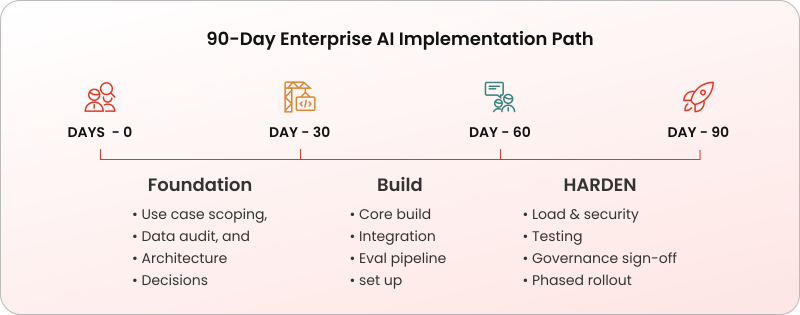
Days 1–30: Foundation & Scoping
The first month is where most of the risk gets removed rather than added. In our experience, that means:
- Use case selection against a value threshold, not "what's interesting" but what has a measurable outcome and an owner accountable for it
- A data audit targeted to the specific use case, checking whether the data this system needs actually exists, is accessible, and is clean enough to act on
- Architecture decisions locked early: RAG versus fine tuning, build versus buy, which orchestration layer, where the vector store lives. These get harder and pricier to change after week six
- Governance stakeholders in the room from day one, with legal, security, and compliance reviewing the plan before code gets written, not after it's built
Days 31 to 60: Build, Integrate, Govern
This is where the system takes real shape against live systems, not sample data:
- Core application build against production data connections
- Integration with the systems of record the use case actually touches, whether that's a CRM, an ERP, a ticketing tool, or a document repository
- Evaluation pipeline built alongside the feature, not after it. Every output gets scored against defined quality criteria before it reaches a user
- Access controls and logging built into the API layer, not wrapped around it later
Days 61 to 90: Production Hardening and Rollout
The final stretch proves the system holds up under real conditions:
- Load testing at expected peak volume, not average volum
- Security review and penetration testing wherever the use case touches sensitive data
- Governance sign off against the organization's risk framework
- Phased rollout to a limited user group first, with monitoring in place to catch failure patterns before a company wide launch
Architecture Decisions That Determine Whether You Scale
Build vs. Buy vs. Integrate
Most enterprise GenAI systems today aren't built from scratch. They're assembled from a foundation model API, an orchestration layer, a vector store, and custom integration code connecting all of it to internal systems. The decision that actually matters isn't which model to use. It's how much of the surrounding infrastructure, evaluation, observability, access control, gets built versus adopted from an existing platform.
RAG vs. Fine Tuning at the Outset
Retrieval augmented generation keeps the model grounded in current, verifiable enterprise data and is easier to audit, since you can trace an output back to a source document. Fine tuning bakes behavior into the model itself and is harder to update or explain later. Most production systems start with RAG and reserve fine tuning for narrow, stable tasks where retrieval latency is the actual bottleneck.
Where Governance Has to Live
Governance handled through a separate compliance review, disconnected from the technical build, is one of the most common reasons a finished system stalls before launch. It needs to be architected in from the start: logged decisions, access controls tied to data sensitivity, and an audit trail a security reviewer can actually inspect, not a slide deck written after the fact.
Governance and Risk: Aligning to NIST AI RMF From Day One
The
NIST AI Risk Management Framework and its Generative AI Profile give enterprises a shared vocabulary for AI risk that security and legal teams already recognize, and that matters more than most technical teams assume. A governance conversation grounded in a recognized framework moves faster than one built from scratch. The framework organizes risk management into four functions: govern, map, measure, and manage. Mapping a 90 day build against those four, who owns AI risk decisions, what risks are specific to this use case, how output quality gets measured, and how the team responds when something goes wrong, turns governance from a blocker into a checklist that runs alongside the technical build instead of after it.
Measuring Success: KPIs Beyond 'It Works in Demo'
| KPI Category | Example Metric | Why It Matters |
|---|---|---|
| Accuracy | Percentage of outputs passing evaluation threshold | Determines if the system is trustworthy at scale |
| Adoption | Weekly active users versus eligible users | Reveals whether the system actually fits the workflow |
| Cost efficiency | Cost per resolved task versus manual baseline | The number finance genuinely cares about |
| Latency | Time to first useful output | Determines whether users tolerate or abandon the tool |
| Governance | Percentage of decisions logged and auditable | Determines whether legal signs off on scaling it |
Teams that only track whether the system launched tend to miss the metrics that decide whether it survives its second quarter in production.
Deploying Enterprise GenAI With Ccube
Ccube runs enterprise GenAI deployments against the same 30/60/90 day structure described above. It's not a marketing framework we point to; it's the operating model behind every AI engagement, whether it's delivered through a Strategy Blueprint, a Turnkey Managed POD, or a Talent Surge engagement embedded inside your existing team.
In practice, that looks like:
- Silicon Valley strategy paired with global delivery execution. Architecture and governance decisions are shaped by a Cupertino based team working directly with your CTO or VP of Technology, while build and integration work runs through Ccube's Indore delivery center. Enterprises get senior strategic input without paying Silicon Valley rates for every hour of implementation.
- POD based turnkey delivery. Instead of staffing a single generalist team, Ccube assembles a dedicated pod, data engineers, AI/ML engineers, and a delivery lead, scoped to the specific use case, so the 30/60/90 timeline isn't competing with other client work for the same engineers.
- Vertical specific governance patterns. BFSI and Healthcare engagements build compliance mapping (SOC 2, HIPAA, relevant financial regulations) into the Days 1 to 30 foundation phase rather than treating it as a Day 89 afterthought. Aviation and Energy engagements weight uptime and predictive reliability metrics into the KPI framework from the start.
- 10,000+ vetted specialists available for Talent Surge engagements when a production deployment needs to scale faster than an internal team can hire.
What enterprises consistently point to isn't a faster demo. It's a system that's still running, still trusted, and still measured six months after launch, because governance and cost visibility were architecture decisions from day one instead of something bolted on in month four.
Explore Ccube's
generative ai development services
to see how the 30/60/90 day framework applies to your specific use case, or read our companion piece on why most enterprise AI pilots never reach production for a closer look at where these initiatives tend to stall.
Ready to assess your GenAI deployment readiness?
Let's evaluate your enterprise data architecture, governance pipelines, and business value metrics together to ensure a friction-free 90-day execution.
Frequently Asked Questions
How long does it actually take to deploy enterprise GenAI into production?
Most well scoped use cases can reach production within 90 days if data access, architecture, and governance stakeholders are engaged from week one. Projects that skip early governance review typically add four to eight weeks of rework before launch.
Do we need to fine tune a model, or is retrieval augmented generation enough?
Most enterprise use cases are better served by RAG, since it keeps outputs grounded in current, auditable source data. Fine tuning earns its added complexity mainly for narrow, stable tasks where retrieval latency is the limiting factor.
What's the biggest reason enterprise AI pilots don't reach production?
Data readiness and governance, more often than model quality. Systems that work well on a sample dataset frequently break against live, fragmented enterprise data, and governance reviews introduced late in the process routinely stall launches that are otherwise technically complete.
How do we estimate the ongoing cost of running a production GenAI system?
Build a cost per request model during the Days 1 to 30 foundation phase, based on expected token volume, model choice, and infrastructure overhead, rather than waiting until after launch. Teams that skip this step are consistently surprised by month two spend once real usage replaces pilot scale testing.
Ready to ship your next AI initiative?