
LLMOps Architecture Best Practices: Scaling Models Beyond Prototypes
September 25, 2026
LLMOps Architecture
Enterprise Scale

LLMOps architecture is the set of infrastructure layers, orchestration, evaluation, observability, and governance that let large language model applications run reliably in production. It differs from traditional MLOps by managing non-deterministic outputs, prompt versioning, and continuous quality evaluation rather than static model metrics.
A prototype built on a single API call to a foundation model can look production ready in a demo. It rarely survives contact with real users, real data volume, or a security review. The gap between "the LLM call works" and "the LLM system is production grade" is almost entirely architectural, and it's the layer most teams skip because the demo never needed it.
This guide breaks down what actually belongs in an enterprise LLMOps stack, the mistakes that keep teams from scaling past their first use case, and how to think through build versus buy.
What LLMOps Actually Covers (And Where It Differs From MLOps)
Traditional MLOps assumes a model with deterministic, measurable outputs. A classifier is right or wrong, a regression model's error is quantifiable. LLMOps has to manage systems where the same input can produce different, still valid outputs, where "correctness" is often a judgment call, and where the artifact under version control isn't just the model. It's the prompt, the retrieval logic, and the model together.
| Traditional MLOps | LLMOps | |
|---|---|---|
| Core artifact | Trained model weights | Prompt + retrieval logic + model configuration |
| Output evaluation | Deterministic accuracy metrics | Quality scoring against rubrics, human review sampling |
| Versioning unit | Model version | Prompt version, model version, and retrieval index version together |
| Cost driver | Training compute (one-time, mostly) | Inference cost per request (continuous, scales with usage) |
| Failure mode | Model drift over time | Hallucination, prompt injection, retrieval mismatch |
Teams that apply MLOps thinking directly to LLM systems tend to under-invest in evaluation and over-invest in model selection — optimizing for which foundation model to use, when the bigger production risk is usually in the layers around it.
The Architecture Stack: From Prompt to Production
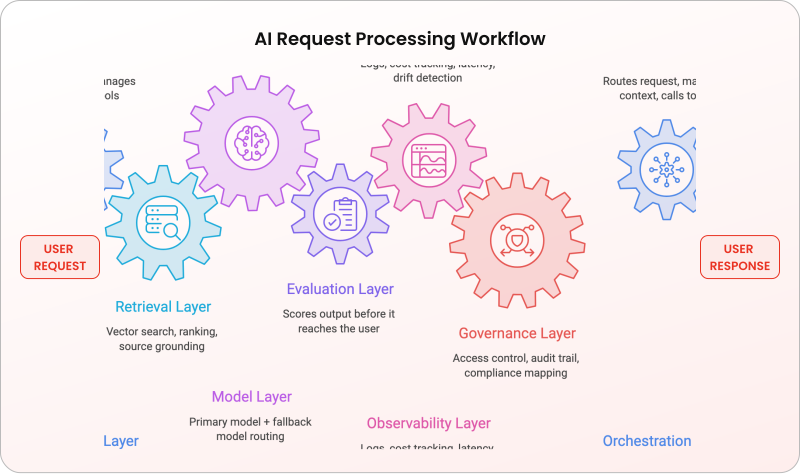
Each layer exists because a specific production failure showed up without it. Skipping the evaluation layer means quality regressions ship silently. Skipping observability means nobody notices cost creeping 3x month over month until finance asks why. Skipping governance means the system works fine until a security review blocks the rollout in week eleven.
Core Components Explained
Prompt & Context Management
Prompts in production aren't static strings — they're versioned artifacts that change based on testing results, get rolled back when a change degrades quality, and need an audit trail showing which version generated which output. Treating prompt changes like code changes — reviewed, versioned, tested before deployment — is the single highest-leverage habit separating teams that scale from teams that don't.
Model Routing and Fallback
Production systems rarely run on one model for everything. A routing layer sends simple, high-volume requests to a smaller, cheaper model and reserves the most capable (and expensive) model for requests that need it, with fallback logic if a primary model call fails or times out. This is as much a cost control mechanism as a reliability one.
Evaluation Pipelines
Every output that reaches a user should pass through automated scoring against defined criteria — factual grounding, relevance, tone, safety — before evaluation samples get reviewed by a human on a regular cadence. Without this, "did the last prompt change make things better or worse" becomes a guess instead of a measurement.
Observability & Cost Monitoring
Token spend, latency, and error rates need to be tracked per use case, not just in aggregate. A system that's cheap in testing can become expensive fast once real usage patterns emerge — long context windows, chatty back-and-forth sessions, retries after failed evaluations all add cost that a pilot-scale test never surfaces.
Governance & Access Control
Every request needs a traceable answer to: who made it, what data did it touch, and is that access appropriate for that user's role. This isn't optional infrastructure for regulated industries — it's the layer that determines whether legal signs off on a company-wide rollout or sends the project back for rework.
Common Architecture Mistakes That Block Scale
| Mistake | Consequence |
|---|---|
| No evaluation pipeline, relying on spot-checks | Quality regressions ship unnoticed until a user complains |
| Single model with no fallback | Full outage when the primary model API has downtime |
| Prompts hardcoded in application logic | Every prompt change requires a full deployment cycle |
| No per-request cost tracking | Budget surprises once usage scales past pilot volume |
| Governance added after the build | Security review blocks launch in the final week |
Every one of these is cheap to fix in week two of a build and expensive to fix in week ten. That's the core argument for treating LLMOps architecture as a day-one decision, not a post-launch upgrade.
Build vs. Buy: Choosing Your LLMOps Stack
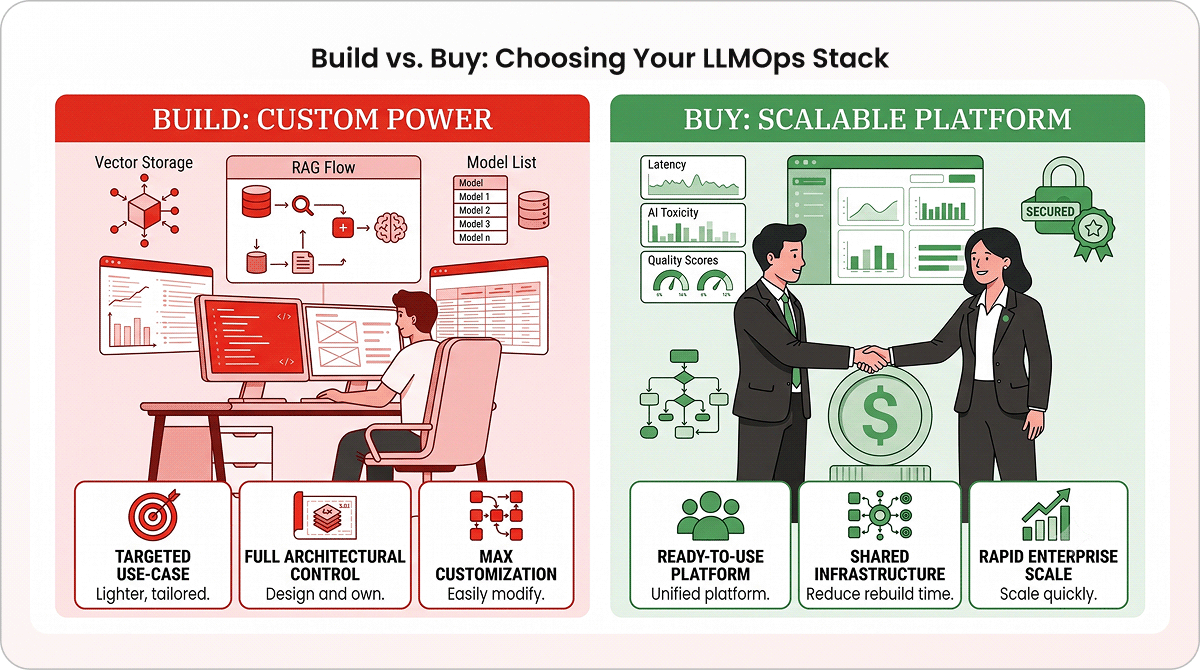
There's no universally correct answer here — the right call depends on how many LLM use cases the organization plans to run and how quickly. A single, well-defined use case can often run on a lighter, mostly custom stack. An organization planning to deploy AI agents across multiple business functions benefits from investing in a shared orchestration and evaluation layer early, so the second and third use cases don't each require rebuilding the same infrastructure from scratch.
The NIST AI Risk Management Framework is a useful reference point regardless of which path an organization chooses — it gives the governance layer a structure that's recognizable to security and compliance reviewers, which matters when a build-vs-buy decision eventually needs sign-off from outside the engineering team.
Deploying LLMOps Architecture With Ccube
Ccube builds LLMOps architecture as a foundational layer of every production GenAI engagement, not an add-on requested after a pilot has already stalled. That includes:
- Full-stack builds. from orchestration and retrieval through evaluation, observability, and governance — architected together rather than assembled from disconnected tools after the fact.
- 30-60-90 day delivery. with the evaluation and observability layers built in parallel with the core application, so quality measurement exists from the first production request rather than being retrofitted after launch.
- POD-based delivery combining Silicon Valley architecture leadership with Indore-based build execution, giving enterprises senior technical direction without staffing every engineering hour at Cupertino rates.
- Governance patterns built for regulated verticals — BFSI and Healthcare engagements map the governance layer directly to compliance requirements from the Days 1–30 foundation phase.
Enterprises evaluating Ccube's
llmops consulting services are usually past the pilot stage and trying to scale a first use case into a repeatable platform. Read our guide on choosing an LLMOps partner for production AI deployment for the evaluation criteria worth applying before selecting a delivery partner.
Ready to assess your LLMOps architecture?
Let's evaluate your LLMOps stack — orchestration, evaluation, observability, and governance — to ensure your architecture scales beyond the prototype.
Frequently Asked Questions
What's the difference between LLMOps and MLOps?
MLOps manages deterministic models with measurable accuracy metrics. LLMOps manages systems with non-deterministic outputs, versioning prompts and retrieval logic alongside the model itself, and relies on quality scoring rather than a single accuracy number.
Do we need a full LLMOps stack for a single use case?
Not necessarily at full scale, but the core layers — evaluation and basic observability — are worth building even for one use case, since they're the layers that catch quality regressions before users do. The shared orchestration layer becomes worth the investment once a second or third use case is on the roadmap.
How do we control LLM inference costs as usage scales?
Model routing (sending simple requests to smaller models), per-request cost tracking, and caching repeated retrieval queries are the three highest-impact levers. Cost tracking has to exist before scale hits, not after a budget overrun gets noticed.
Why does governance need to be part of the architecture instead of a separate compliance review?
Because retrofitting access controls and audit logging into a system that wasn't built with them is significantly more expensive than building them in from the start, and it's the most common reason a technically finished system stalls in the final review before launch.
Ready to ship your next AI initiative?