
The Future of Contract Catering: How AI, Data & Digital Platforms Are Transforming Enterprise Food Service Operations
May 20, 2026
AI-Powered Intelligence
Enterprise Food Service Operations
Contract Catering
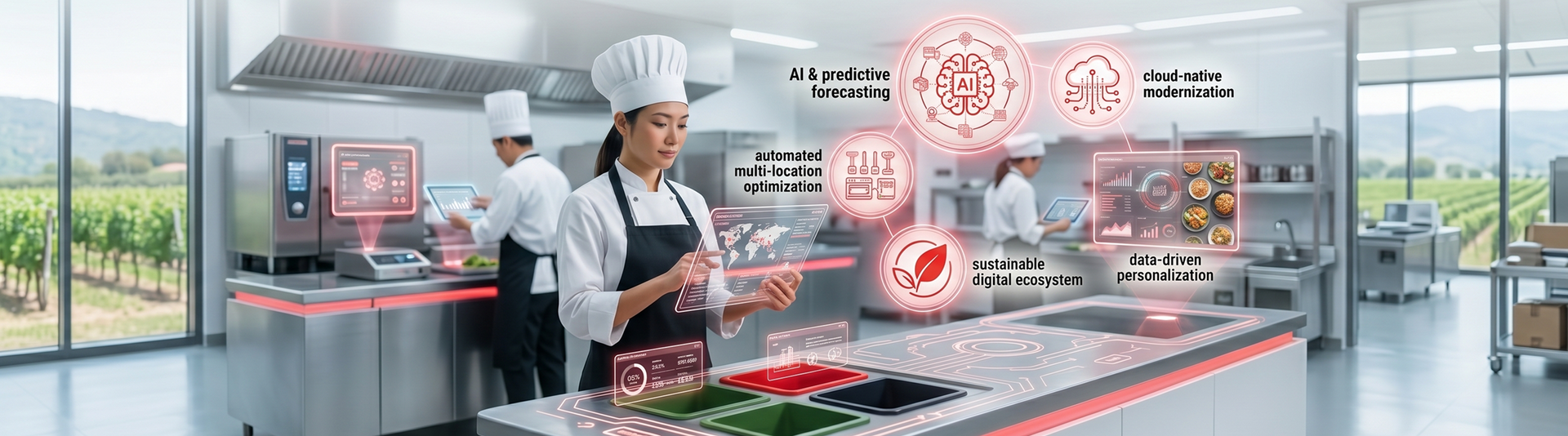
The contract catering and food service industry is entering one of the biggest transformation phases in its history.
For decades, operational success in food service was largely measured through consistency, efficiency, and scale. Organizations focused on delivering quality meals, optimizing procurement, managing labor costs, and maintaining service standards across locations.
Those priorities still matter.
But today, enterprise food service organizations are operating in an entirely different environment — one shaped by sustainability pressures, operational complexity, real-time customer expectations, distributed workforces, and rapidly evolving technology.
They are managing large-scale operational ecosystems that span:
- Thousands of cafés and kitchens
- Multiple geographies
- Supplier and procurement networks
- Sustainability initiatives
- Food standards compliance
- Operational reporting systems
- Workforce coordination
- Inventory forecasting
- AI-driven analytics
- Customer engagement systems
As this complexity continues to grow, one thing is becoming increasingly clear:
The future of contract catering will not be defined only by food quality or operational scale.
It will be defined by operational intelligence.
And operational intelligence is powered by technology.
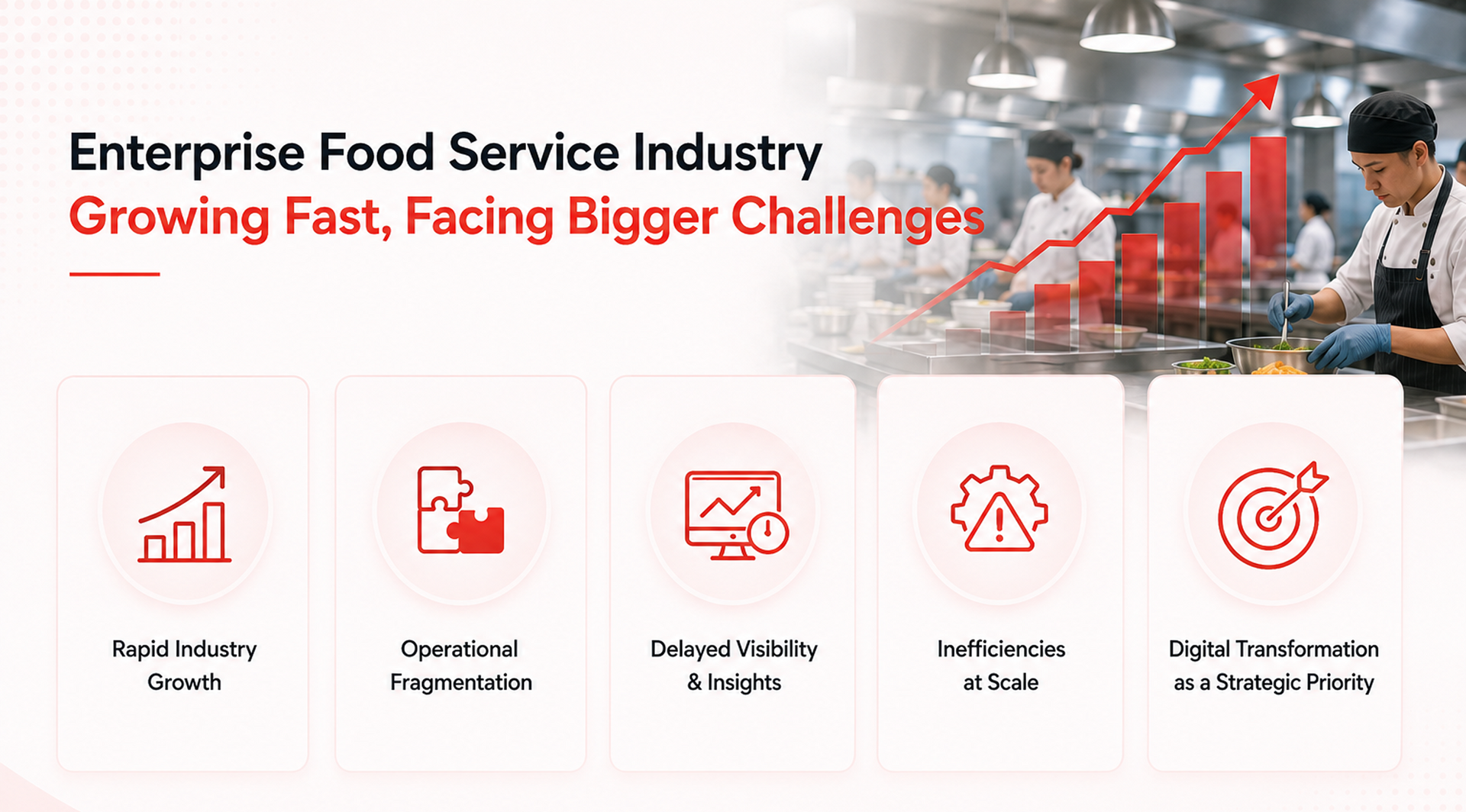
The Enterprise Food Service Industry Is Growing Rapidly - But So Are Operational Challenges
According to Allied Market Research, the global catering and food service contract market was valued at approximately $288.8 billion in 2022 and is projected to reach nearly $497.7 billion by 2032, growing at a CAGR of 5.3%.
This growth reflects increasing demand across:
Corporate dining
Healthcare food services
Educational institutions
Hospitality
Industrial catering
Stadium and venue operations
Campus food ecosystems
But behind this growth lies a much deeper operational challenge.
As organizations scale across locations and regions, operational fragmentation becomes significantly harder to manage.
Many enterprise food service organizations still rely on:
- Disconnected legacy applications
- Spreadsheets and manual reporting
- Siloed operational workflows
- Delayed visibility into performance metrics
- Inconsistent governance across locations
At smaller scale, these inefficiencies may appear manageable.
At enterprise scale, they become costly.
A delayed operational insight across one kitchen may not create major disruption.
The same delay across 1,500 kitchens globally can impact forecasting accuracy, sustainability performance, operational consistency, and profitability.
This is why digital transformation is rapidly becoming a strategic priority across enterprise food service organizations worldwide.
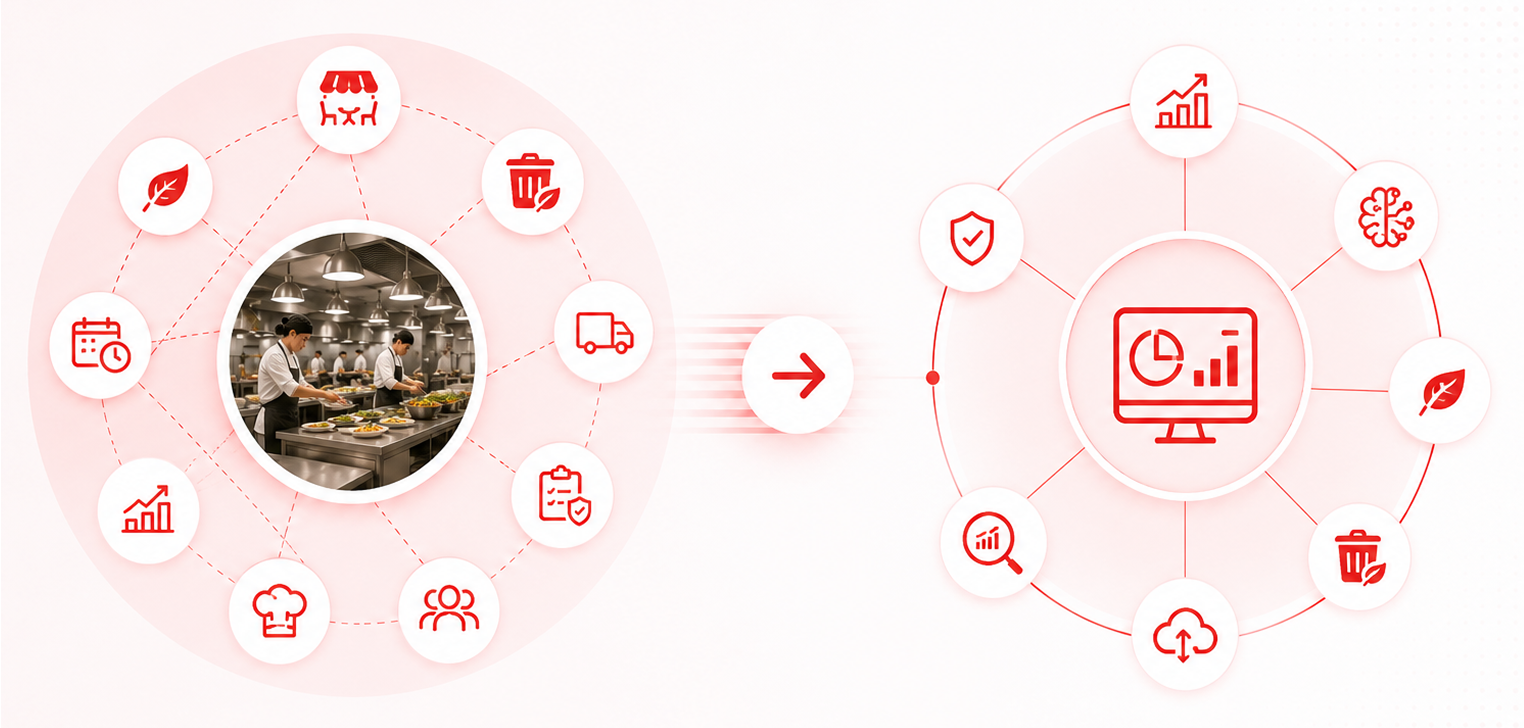
Why Food Service Operations Have Become Increasingly Complex
From the outside, contract catering can appear relatively straightforward.
Meals are prepared. Operations continue. Customers are served.
But behind the scenes, enterprise food service operations involve an extraordinary number of moving parts.
A single global food service enterprise may simultaneously manage:
- Café operations
- Food waste programs
- Supplier ecosystems
- Procurement systems
- Compliance reporting
- Sustainability tracking
- Nutrition and wellness initiatives
- Workforce scheduling
- Inventory planning
- Kitchen operations
- Regional operational governance
The challenge is that many of these systems evolved independently over time.
As organizations expanded, technology ecosystems became fragmented.
Different locations adopted different operational workflows.
Data became isolated across systems.
Reporting became inconsistent.
Operational visibility became delayed.
And over time, organizations accumulated significant operational and technical debt.
This is one of the primary reasons enterprise food service companies are now investing heavily in:
- Food service analytics platforms
- AI-driven forecasting systems
- Sustainability dashboards
- Food waste management software
- Operational intelligence platforms
- Cloud-native enterprise infrastructure
Because fragmented operational ecosystems are becoming increasingly difficult to scale efficiently.

Sustainability Is Reshaping the Future of Food Service
Perhaps the biggest transformation happening in contract catering today is the growing focus on sustainability and food waste reduction.
Sustainability is no longer viewed as a secondary initiative.
It is now directly connected to:
- Operational efficiency
- Profitability
- Procurement optimization
- ESG commitments
- Enterprise reporting
- Client expectations
- Regulatory compliance
- Brand reputation
According to the United Nations Environment Programme (UNEP), the world wastes approximately 1.05 billion tons of food annually.
Food service operations contribute significantly to that number.
For enterprise food service organizations, food waste is no longer simply an operational issue.
It is now a business-critical challenge.
The difficulty is that traditional waste management processes were never designed for modern operational scale.
Many organizations still depend on:
- Manual waste logging
- Spreadsheets
- Delayed reporting
- Disconnected sustainability systems
These approaches limit real-time visibility into operational inefficiencies.
Without centralized data, organizations struggle to identify:
- Recurring waste patterns
- Overproduction issues
- Procurement inefficiencies
- Kitchen-level operational gaps
- Sustainability performance trends
This is where modern food waste management platforms and sustainability analytics systems are creating measurable value.
Today’s enterprise food service organizations are increasingly adopting digital systems capable of:
- Tracking waste in real time
- Monitoring waste destinations
- Generating automated sustainability dashboards
- Forecasting inventory demand using AI
- Identifying operational inefficiencies proactively
- Enabling centralized reporting across locations
This transition from reactive reporting to predictive operational intelligence is fundamentally reshaping food service operations.
AI Is Becoming the Operational Intelligence Layer of Enterprise Food Service
Artificial intelligence is often discussed in the context of automation.
But in enterprise food service, AI is becoming far more important than that.
It is becoming the operational intelligence layer that helps organizations make smarter decisions at scale.
Forward-thinking food service organizations are already using AI to:
- Forecast food demand
- Optimize inventory planning
- Reduce overproduction
- Predict food waste patterns
- Automate operational reporting
- Identify anomalies across locations
- Improve workforce planning
- Optimize procurement workflows
Historically, many operational decisions in food service were based on historical reporting.
Leadership teams looked backward to understand what happened.
AI is changing that model entirely.
Organizations can now begin forecasting:
- Future demand fluctuations
- Operational risks
- Waste spikes
- Procurement needs
- Staffing requirements
- Performance inconsistencies across regions
This shift from reactive operations to predictive operations represents one of the most important technological transformations happening in the industry today.
And we are still in the early stages of that evolution.
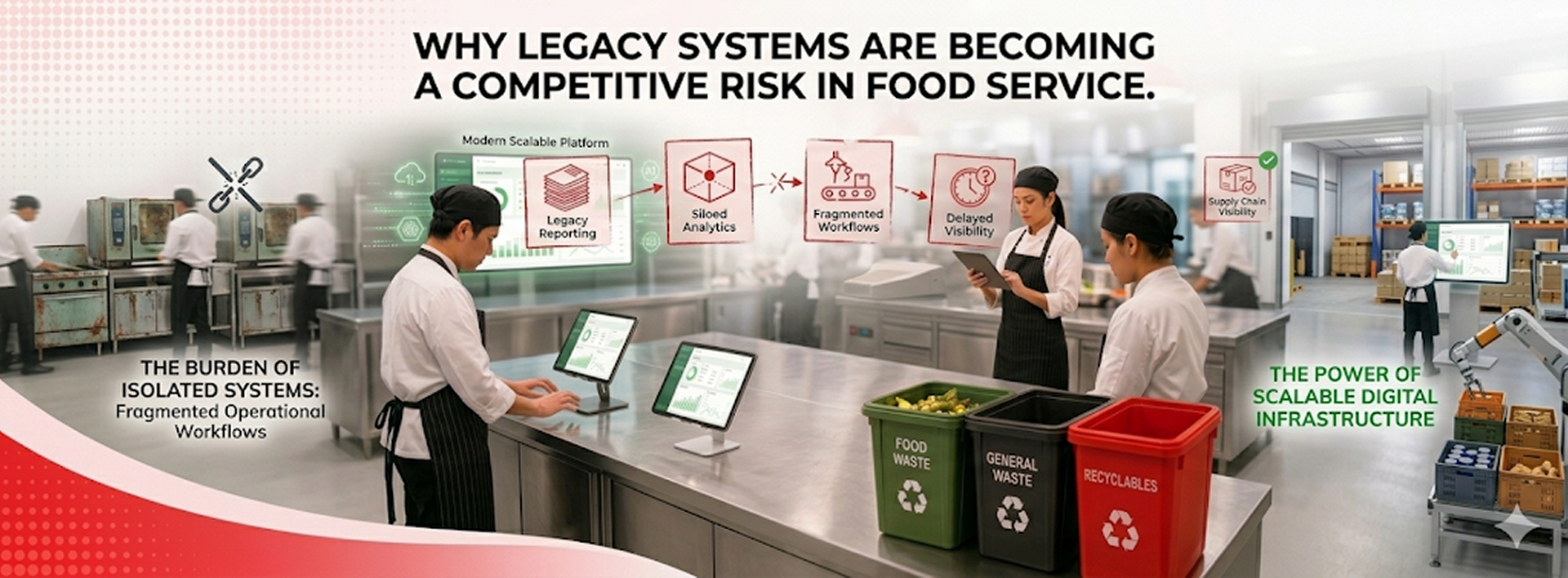
Why Legacy Systems Are Becoming a Competitive Risk
Many enterprise food service organizations expanded rapidly over the past decade.
But operational systems often failed to evolve at the same pace.
As a result, many organizations now depend on:
- Disconnected infrastructure
- Legacy reporting systems
- Fragmented operational workflows
- Siloed analytics
- Outdated architectures
Initially, these limitations appear operational.
Over time, they become strategic obstacles.
Teams spend more time consolidating data than generating insights.
Operational visibility becomes delayed.
System scalability declines.
Feature deployments slow down.
Operational agility decreases.
And innovation becomes harder to implement across locations.
This is why modernization is no longer optional for enterprise food service organizations.
Modern digital infrastructure is now essential for:
- Operational scalability
- Sustainability initiatives
- AI adoption
- Real-time reporting
- Operational visibility
- Enterprise governance
- Multi-location coordination
Organizations that continue relying on fragmented legacy systems will increasingly struggle to scale efficiently in a rapidly evolving industry.
Enterprise Food Service Requires a Different Kind of Technology Partner
One of the biggest misconceptions in the market is that food service technology is simply about restaurant apps or ordering platforms.
Enterprise contract catering requires something fundamentally different.
Modern enterprise food service platforms must support:
- Multi-location operational management
- Sustainability and ESG reporting
- Kitchen workflow optimization
- Supplier visibility
- Operational analytics
- Governance frameworks
- AI forecasting
- Cloud scalability
- Mobile operational applications
- Enterprise integrations
This requires a much deeper level of engineering capability than traditional restaurant technology solutions.
It requires scalable enterprise architecture capable of supporting highly complex operational ecosystems.
This is why enterprise food service organizations increasingly seek technology partners with expertise in:
- Enterprise engineering
- Cloud modernization
- AI integration
- Data platform development
- Sustainability systems
- Operational analytics
- Scalable product engineering
Because successful digital transformation is not simply about deploying software.
It is about building resilient operational infrastructure designed for long-term scalability.
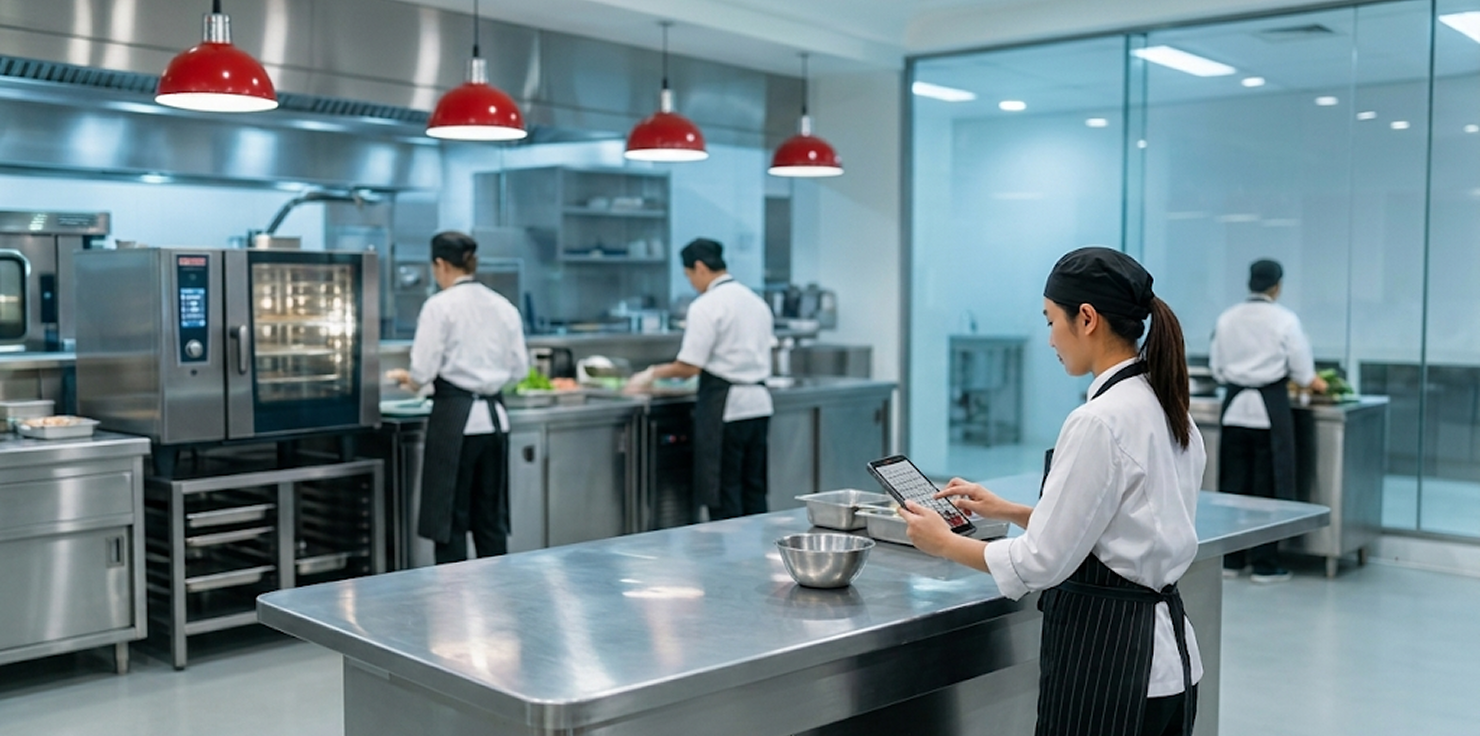
How Enterprise Food Service Organizations Are Modernizing Operations
Across the industry, leading food service enterprises are investing in:
- Centralized operational dashboards
- Food waste management systems
- Sustainability analytics platforms
- AI-powered forecasting tools
- Kitchen operational applications
- Enterprise café management systems
- Cloud-native modernization initiatives
The objective is not simply modernization.
It is operational visibility
One global food service enterprise partnered with Ccube to modernize and scale its operational ecosystem across thousands of locations worldwide.
The initiative included:
- Food waste management platform modernization
- Scalable café management systems
- Sustainability and food standards dashboards
- Operational reporting platforms
- AI-enabled workflows
- Kitchen and tablet-based operational applications
The transformation supported:
- 3,150+ cafés
- 725+ campuses
- 1,500+ kitchens globally
- Operations across 24 countries
By modernizing the organization’s operational infrastructure, the initiative achieved:
- 90% reduction in downtime
- 50% faster platform response times
- 60% faster feature deployment cycles
- Significantly improved operational visibility and scalability
Most importantly, the organization transitioned from fragmented operational systems to centralized operational intelligence.
And that fundamentally changed how teams managed operations at scale.
The Future of Contract Catering Will Be Built on Operational Intelligence
The next generation of food service leaders will not compete only on scale.
They will compete on:
- Operational visibility
- Sustainability performance
- AI-driven forecasting
- Data-driven decision-making
- Real-time operational intelligence
- Digital agility
- Scalable operational infrastructure
Technology is no longer functioning as a support layer for food service organizations.
It is becoming the operational backbone of the industry.
Organizations investing in connected digital ecosystems today will be significantly better positioned to:
- Optimize operations
- Reduce wasteImprove sustainability
- Scale efficiently
- Modernize continuously
- Adapt to changing business demands
The future of contract catering will belong to organizations that can operate intelligently at scale.
And that future is already beginning.
How Ccube Supports Enterprise Food Service Transformation
Ccube partners with enterprise food service and contract catering organizations to modernize operational ecosystems through:
- AI-powered operational platforms
- Food waste management systems
- Sustainability analytics solutions
- Enterprise reporting dashboards
- Cloud-native modernization
- Operational intelligence systems
- Scalable multi-location applications
Our expertise spans:
- Enterprise food service software development
- AI and analytics integration
- Operational reporting systems
- Sustainability technology platforms
- Kitchen and café management applications
- Enterprise cloud infrastructure
- Large-scale digital transformation initiatives
As enterprise food service operations continue evolving, organizations increasingly require scalable digital foundations capable of supporting operational growth, sustainability goals, and long-term innovation.
That is where modern technology partnerships create lasting business value.
Planning to Modernize Your Food Service Operations?
Enterprise food service organizations today are under increasing pressure to improve operational visibility, reduce waste, modernize legacy systems, and scale sustainability initiatives.
Ccube works with enterprise food service and contract catering organizations to build scalable digital ecosystems powered by AI, analytics, and modern cloud infrastructure.
Whether your organization is evaluating:
- Food waste management systems
- Sustainability analytics platforms
- AI-driven forecasting
- Enterprise operational dashboards
- Cloud modernization
- Multi-location operational platforms
Our team can help you identify modernization opportunities aligned with your operational goals.
👉 Book a Free Food Service Technology Strategy Session
In this consultation, we can help evaluate:

Operational visibility gaps
In this consultation, we can help evaluate:
Sustainability reporting challenges
Legacy system limitations
AI and analytics opportunities
Enterprise modernization priorities
How Can We Help You?
Thank you for contacting us.
We will get back to you as soon as possible.
Please try again later.
Frequently Asked Questions
1. What is contract catering technology?
Contract catering technology includes digital platforms and operational systems used to manage enterprise food service operations, including kitchen workflows, sustainability tracking, reporting, analytics, inventory management, and operational visibility.
2. Why is digital transformation important for food service organizations?
Digital transformation helps food service organizations improve operational efficiency, reduce food waste, centralize reporting, enable AI-driven forecasting, modernize legacy systems, and scale operations more effectively.
3. How does AI improve enterprise food service operations?
AI helps forecast demand, optimize inventory, reduce overproduction, automate reporting, improve staffing efficiency, identify operational anomalies, and provide predictive operational insights.
4. What is food waste management software?
Food waste management software helps organizations track, analyze, and reduce food waste through real-time reporting, analytics dashboards, operational monitoring, and sustainability tracking.
5. What are the biggest operational challenges in contract catering today?
Major challenges include fragmented systems, limited operational visibility, food waste, sustainability reporting, legacy infrastructure, inconsistent workflows, and scaling operations across multiple locations.
6. What are sustainability dashboards in food service?
Sustainability dashboards provide centralized visibility into food waste, sourcing, carbon impact, procurement trends, and ESG-related operational metrics across enterprise food service operations.
7. Why are legacy systems difficult for enterprise food service organizations?
Legacy systems often create fragmented workflows, delayed reporting, operational inefficiencies, scalability limitations, and poor integration capabilities across distributed operations.
8. What technologies are commonly used in enterprise food service platforms?
Modern food service platforms use cloud infrastructure, AI/ML systems, data engineering tools, analytics platforms, mobile applications, microservices architecture, and enterprise integrations.
9. Can enterprise food service platforms support global operations?
Yes. Modern cloud-native platforms can support multi-region operations, distributed teams, centralized governance, sustainability reporting, and operational visibility across thousands of locations globally.
10. What should organizations look for in a food service technology partner?
Organizations should look for partners with expertise in enterprise engineering, cloud modernization, AI integration, operational analytics, sustainability systems, scalability, and large-scale operational transformation.
11. How do operational analytics improve food service performance?
Operational analytics provide real-time insights into waste trends, kitchen performance, procurement efficiency, operational bottlenecks, staffing patterns, and sustainability metrics, enabling faster and more informed decision-making.
12. What is the future of enterprise food service operations?
The future of food service operations will be driven by AI-powered forecasting, sustainability intelligence, centralized operational ecosystems, real-time analytics, and scalable digital infrastructure that enables intelligent operations at enterprise scale.