
Why Enterprise AI Starts With a Strong Data Engineering Foundation
October 29, 2026
Enterprise AI
Data Engineering

Most enterprise AI programs do not stall because of the model. They stall because the data feeding it is scattered across systems, refreshed too slowly, poorly described or impossible to share safely. That makes data engineering for enterprise AI the real critical path between a promising pilot and a production system people trust.
The pattern is familiar. A proof of concept works on a hand-picked extract. Then it meets live ERP, CRM and document stores, and months disappear into access requests and security reviews. The model was ready. The data foundation for AI was not.
Quick Answer
Enterprise AI depends on data engineering because a model is only as accurate, current and safe as the data it receives. Data engineering for enterprise AI builds the pipelines, storage, quality checks, governance and serving layers that turn scattered business data into reliable, permissioned inputs for ML models, RAG applications and AI agents. Without that foundation, pilots work on samples and fail on live systems.
Key Takeaways
- Enterprise AI is held back by data access, freshness, context and governance, not model choice.
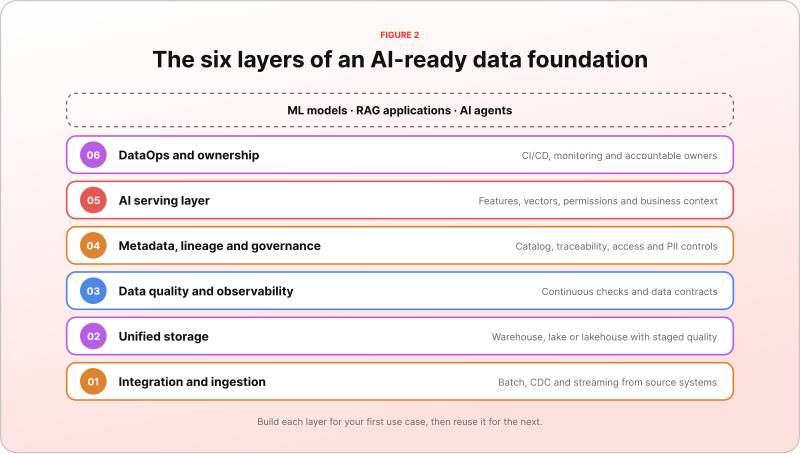
- An AI-ready foundation has six layers: integration, storage, quality, governance, AI serving and DataOps.
- Requirements rise from predictive ML to RAG to AI agents, because agents act on live systems.
- Build one use case at a time, to production standard, and reuse each layer for the next.
What Data Engineering for Enterprise AI Means
Data engineering for enterprise AI is the design and operation of pipelines, storage, quality controls, metadata and serving layers that deliver accurate, current, governed data to ML models, generative AI applications and AI agents, in the form each one needs.
Most enterprises already move data into a warehouse for reporting. What changes with AI is the consumer. A dashboard reader who sees an odd number asks a colleague. A model learns from it, or repeats it to a thousand users.
How It Differs From Data Engineering for BI
BI data engineering vs data engineering for enterprise AI
| Dimension | BI and reporting | Enterprise AI |
|---|---|---|
| Consumer | People reading dashboards | Models, RAG apps and agents using data directly |
| Data types | Mostly structured tables | Tables plus documents, tickets, email and logs |
| Freshness | Daily or weekly batch | Near real time for many decisions |
| Quality tolerance | People work around gaps | Models learn errors and repeat them at scale |
| Governance | Who can open a report | What each user's AI can retrieve or do |
Where the Data Foundation Sits in the AI Stack
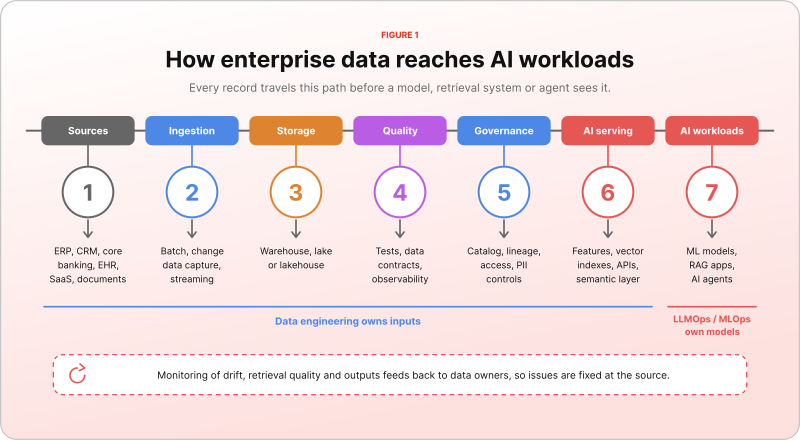
Data engineering owns everything up to the AI serving layer: the right data arrives on time, with meaning and permissions attached. From there, LLMOps and MLOps take over deployment, evaluation and monitoring. Programs that reach production define that handoff explicitly.
Why Enterprise AI Stalls Without a Data Foundation
Leaders rate their data highly while naming it as the main obstacle to AI. In the Cloudera Data Readiness Index of 1,270 IT leaders, 84% trust their data, yet nearly 80% say limited data access constrains AI and only 18% call their data fully governed. A Precisely and Drexel LeBow study of 500+ data leaders found 88% report AI-ready data, while 43% call data readiness their biggest barrier to aligning AI with business goals.
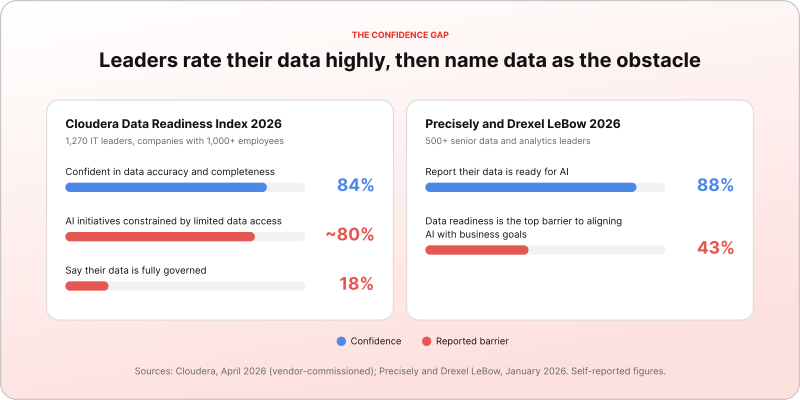
The confidence gap. Sources: Cloudera (April 2026), Precisely and Drexel LeBow (January 2026). Self-reported figures.
Readiness is usually judged against reporting workloads. AI-ready data is fit for a specific use case: accessible, current, representative of real conditions, described so a machine can interpret it, and governed. Clean data can fail all five tests.
The Pilot Trap
Pilots run on curated snapshots with broad access. Production needs live feeds, per-user permissions, audit traceability and named owners on call. None of that is about the model. The most common failures are:
- Siloed data that takes months of approvals to reach
- Quality problems that models amplify into confident, wrong outputs
- Stale data from nightly batches feeding real-time decisions
- No lineage, so outputs cannot be explained or audited
- Ungoverned access, so AI surfaces data a user should never see
The Six Layers of an AI-Ready Data Foundation
Most enterprises have each layer in some form. The work is raising it to the standard AI requires, starting with what your first use case needs.
1. Integration and Ingestion
Moves source data into a shared platform through batch loads, change data capture (CDC) for near-real-time updates, and event streaming. For older estates, modernizing legacy data platforms is usually the first, and most reusable, cost of AI. Missing if: AI teams request CSV exports by email.
2. Unified Storage
A governed warehouse, lake or lakehouse, often on Snowflake, Databricks, AWS, Azure or Google Cloud. A medallion architecture (bronze, silver, gold) keeps every stage traceable, so a model issue can be followed back to the raw record. Missing if: one customer has five IDs in five systems.
3. Data Quality and Observability
Continuous monitoring of freshness, volume, schema and value distributions, with alerts routed to named owners. Data contracts between producers and consumers make breaking changes fail loudly instead of silently corrupting model inputs. Missing if: you learn about data issues from bad AI answers.
4. Metadata, Lineage and Governance
A catalog, lineage from source to AI output, PII and PHI classification, and central access policy. Lineage is what makes an AI decision auditable. Strong data governance and management lets security teams approve AI launches instead of blocking them. Missing if: nobody can say what data the AI can reach.
5. The AI Serving Layer
The layer most BI-era platforms lack: feature pipelines for ML, a RAG data pipeline for generative AI, and permission-aware retrieval so users only get answers from content they may see. The OWASP Top 10 for LLM applications treats vector and embedding weaknesses as a distinct security risk.
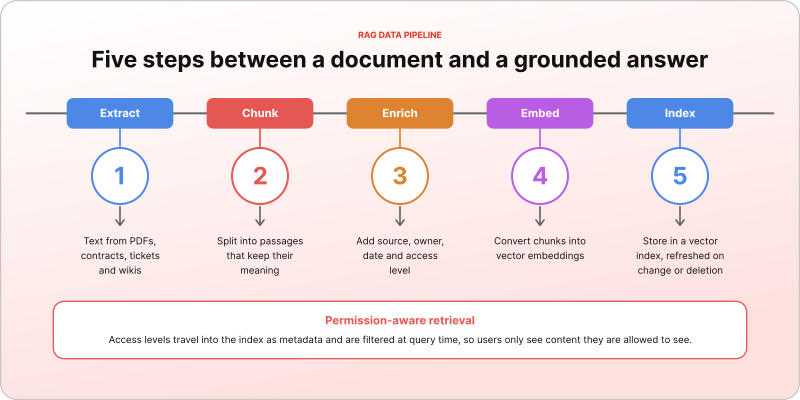
Figure 3. The RAG data pipeline, with permission-aware retrieval at query time.
Agents also need a semantic layer that defines terms such as "active customer" once. As Thoughtworks' Pramod Sadalage and Prem Chandrasekaran write in their guide to agent-ready data, "When the data feels wrong, a human double-checks; an agent confidently acts on it." Missing if: every AI team builds its own embeddings and metric definitions.
6. DataOps and Ownership
CI/CD, testing and monitoring for pipelines, named owners for critical datasets and a defined handoff to model operations. Missing if: pipeline failures surface days later.
What Different AI Use Cases Demand From Your Data
Requirements rise as AI moves from predicting, to answering, to acting.
AI use case data requirements
| Requirement | Predictive ML | GenAI with RAG | AI agents |
|---|---|---|---|
| Example | Demand forecasting, credit scoring | Policy Q&A, contract review | Updating CRM records, triaging claims |
| Freshness | Hours to days | Minutes to days | Seconds to minutes |
| Governance priority | Explainability, reproducibility | Permission-aware retrieval | Least-privilege access, audit trail of actions |
| Layers most stressed | Storage, quality, features | Ingestion, metadata, vectors | Integration, semantic layer, governance |
Agents raise the bar most: an outdated record produces a wrong action, not just a wrong answer. If enterprise AI and AI agent development is on your roadmap, design the semantic layer and access model first, even for platforms built for AI agents that work with enterprise data.
Data Engineering for AI in Regulated Industries
In regulated sectors, the data foundation is also the compliance foundation. The controls below are engineering practices, not legal advice.
- [Financial services](BFSI): lineage from transaction to decision, versioned training data for audits and streaming for fraud, supporting GLBA, SOX and CCPA programs.
- [Healthcare](HC): minimum-necessary PHI access, de-identification following HHS guidance and audit logs of AI access under HIPAA.
- Aviation, energy and food services: streaming sensor data, tight freshness alerts and resilient pipelines for predictive maintenance.
How to Tell Whether Your Data Is Ready for AI
Assess your readiness for the next AI use case you plan to fund. Review the statements below and identify which capabilities are already in place.
- Use case clarity: The use case and the exact data it requires are clearly defined.
- Data accessibility: Data can be accessed programmatically in days, not months.
- Data freshness: Data refreshes at the frequency required by the decisions it supports.
- Data quality: Quality is monitored continuously, with clear ownership for resolving issues.
- Traceability: AI outputs can be traced back to their source records.
- Data security: Sensitive fields are classified and masked before reaching AI systems.
- Access control: Data retrieval and AI agent tools respect each user's permissions.
- Consistent definitions: Core business terms are clearly defined and used consistently across systems.
- Unstructured data readiness: Documents are inventoried, assigned owners and prepared for processing.
- Team alignment:
Data and AI teams have an agreed process for collaboration and handoffs.
What your assessment reveals: Multiple gaps in the same area indicate where investment should begin. Address governance and access-control gaps before launch, as they introduce security and compliance risks, not just implementation delays.
Found gaps in more than one layer? Talk to a data architect about a use-case-led readiness review.
Build the Foundation Without Freezing Your AI Roadmap
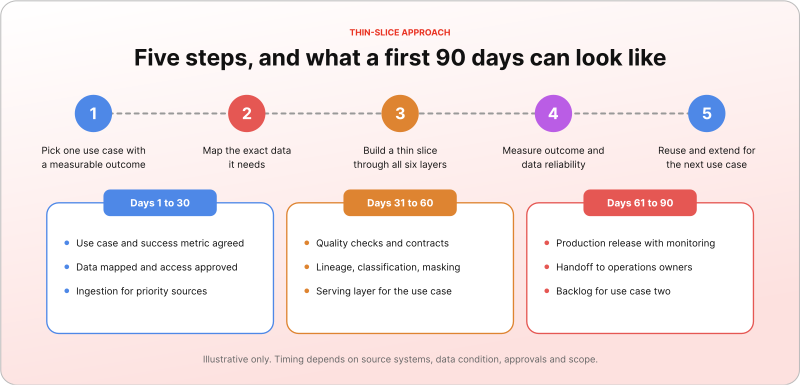
Do not pause AI for a multi-year cleanup, and do not ship AI on ungoverned extracts either. Build the foundation one use case at a time:
- Pick one use case with a measurable outcome, such as faster claims triage.
- Map the exact data it needs sources, freshness, sensitivity and owners.
- Build a thin slice through all six layers, to production standard.
- Measure the business outcome alongside data reliability.
- Reuse shared pipelines, policies and definitions for the next use case.
Who Should Own the Data Foundation: Build, Buy or Partner
Delivery models for the data foundation
| Model | Best when | Watch out for |
|---|---|---|
| Build in-house | You have platform engineers with capacity | Hiring time; new skills like vector search |
| Platform-led | You are standardizing on one platform | Tools are not decisions; vendor lock-in |
| Partner-led | You need production faster than hiring allows | Knowledge transfer; partners covering only data or only AI |
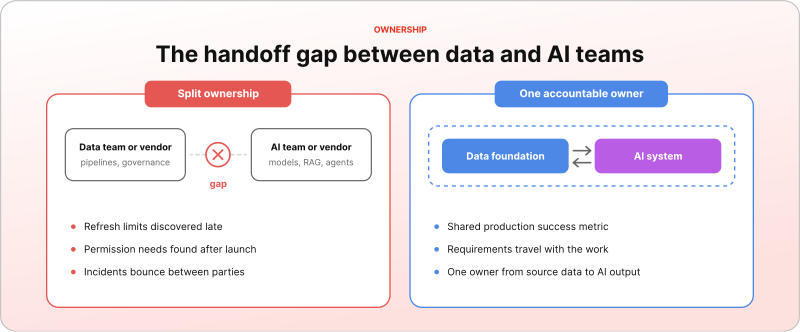
Whichever model you choose, avoid the handoff gap. When one team builds pipelines and another builds the AI, requirements get lost and incidents bounce between them. Give one owner accountability from source data to AI output.
Frequently Asked Questions
What is data engineering for AI?
Collecting, cleaning, describing, governing and serving enterprise data so ML models, generative AI and agents can use it reliably.
How is AI-ready data different from clean data?
Clean data has no obvious errors. AI-ready data is also accessible, current, representative and governed for one specific use case.
Why do AI pilots fail to reach production?
Pilots use curated snapshots. Production needs live data, per-user permissions, lineage and monitoring, which surface late.
Do we need a lakehouse before using AI?
No. Many use cases run well on a governed warehouse plus a document pipeline.
What does RAG need from data engineering?
Text extraction, chunking, metadata, embeddings, a refreshed vector index and permission-aware retrieval.
How do AI agents change data requirements?
Agents act on live systems, so they need current data, clear business definitions, task-scoped access and a full audit trail.
What is a semantic layer?
Governed definitions of business metrics and entities, so every model and agent means the same thing by terms like net revenue.
How long does an AI-ready foundation take?
Enterprise-wide, years. A thin slice for one production use case, much sooner.
Should one team own data and AI?
Not necessarily the same people, but one accountable owner and one shared production metric.
How does Ccube help?
Ccube delivers data engineering, AI development and applications through one team, planned as a use-case-led 30-60-90 day roadmap.
Conclusion: The Model Is Rarely the Constraint
Enterprise AI succeeds or stalls on its data foundation far more often than on its model. Data engineering for enterprise AI decides whether a pilot survives live systems, real users and auditors. Start with the checklist above and fund the layer your next use case needs most.
Build the data foundation and the AI on top of it, with one team
Ccube brings
data engineering and integration together with
AI agent development and
LLMOps, so pipelines, governance and models are delivered against one production outcome.
Ready to ship your next AI initiative?